
Frost, Heat, & Hail
You can’t plan the weather, but you can plan how you’ll respond when it hits. I’ll walk you through the key principles, grounded in research and on-farm experience. If you want the full breakdown, check out my full article in Better Farming Prairies this month.

In case you’re new here, let me introduce myself. My name is Scott Gillespie and I’m an Alberta-based author, podcaster, and independent agronomy consultant focusing on practical, science-backed advice. I have nearly two decades of experience in dryland and irrigated specialty crop systems, working across organic, conventional, and regenerative farms.
Same content. Different formats.
Damage Control: Frost, Heat, & Hail
Your response doesn’t have to be unpredictable.
Frost – Don’t Rush It
Frost damage is hard to look at, but the worst thing you can do is make a quick decision. Give your crops time—usually five to seven days—to show whether they’ll recover. Cereals like wheat and barley often survive better than broadleaf crops, since their growing point is below ground early on.
Even if the stand is thinner than you’d like, it might still out-yield a late reseed, especially if it’s uniform. The cost and delay of reseeding can sometimes do more harm than good.
Heat – It’s All About Timing
Heat stress hurts most when it lines up with flowering. Canola and peas are especially sensitive—canola can abort flowers at just 27°C with warm nights, and peas often shut down early in dry heat.
Lentils and chickpeas handle heat better, but even they can struggle in long, hot spells. For cereals, heat during grain fill shrinks kernel size and test weight.
The best defence? Avoidance. Earlier seeding gives your crop the best shot at getting through sensitive stages before peak summer heat hits.
Hail – Patience, Then a Plan
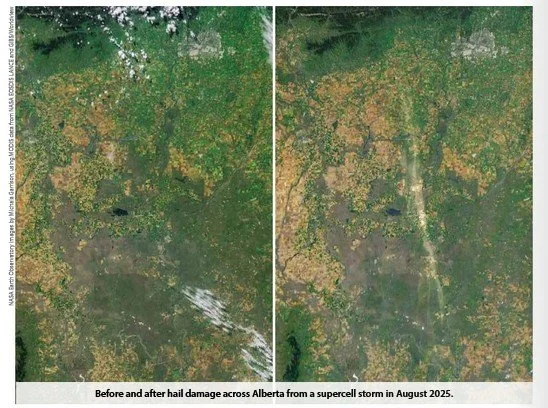
Hail is a wildcard. It doesn’t matter how good your agronomy is—when it hits, it hits hard. But not every hailed crop is a write-off.
If it strikes early, many crops can regrow. If it hits late, recovery is limited. The best thing you can do is to have the most insurance you can. The insurance can soften the financial blow, but then you can look to getting some value from it. It could be seen as a soil health year or it could be used or sold for animal feed.
Three rules before feeding it:
Always report to your insurance provider before doing anything.
Check grazing intervals. If you sprayed a fungicide recently, it may not be
safe to feed it yet
Get the crop tested before cutting or grazing — it could be high in nitrates.
Always consult your nutritionist first, or advise the purchaser to test to be sure.
Rescue Products
You’ll hear a lot of claims about foliar nutrients, biostimulants and recovery sprays—especially after a stress event. Some of these products have valid uses, but most don’t show consistent yield benefits in third-party trials unless you have a known deficiency or specific disease.
Plants start responding to stress on their own immediately. What they need most is time, sunlight and moisture. If you’re curious about a product leave at least one check strip.
Fertilizer and Fungicides – Be Strategic
Some will say a hailed crop needs more nitrogen to recover. That depends. If you already fertilized well and your yield potential is lower, extra N might not pay, especially if maturity gets pushed back into frost risk territory.
Fungicides? Use them when disease pressure is real—not just because the crop looks rough. And remember: most disease after hail is bacterial. Fungicides won’t protect you from those.
To read the complete article use the link below or look for:
Better Farming Prairies, May/June 2026, p.50
Closing remarks
Thanks for your attention! If something resonated let me know. I love to hear from people. Also, sharing this episode in your social networks, whether a post or to small group of your friends, colleagues, or clients, is very much appreciated. You can also support me by picking up a copy of my book, Practical Regeneration, or reaching out for agronomy support.
All the information can be found on my website:
www.plantsdigsoil.com
Here’s to growing more, believing less, and always digging a little deeper.