

Navigating Fertilizer Uncertainty
Have recent geopolitical events left you short on nitrogen? Or are you holding back due to high input costs and uncertainty around how much you’ll sell the crop for?
The good news is that for most of our other nutrients we can short them for one year as long as we haven’t been shorting them for many years. When you keep up with replacement then you have a buffer in place.
Nitrogen is not like this. Applying some upfront is nearly always needed. There’s always the option to top up later—if conditions improve and product is available.
But just because you can doesn’t always mean you should.
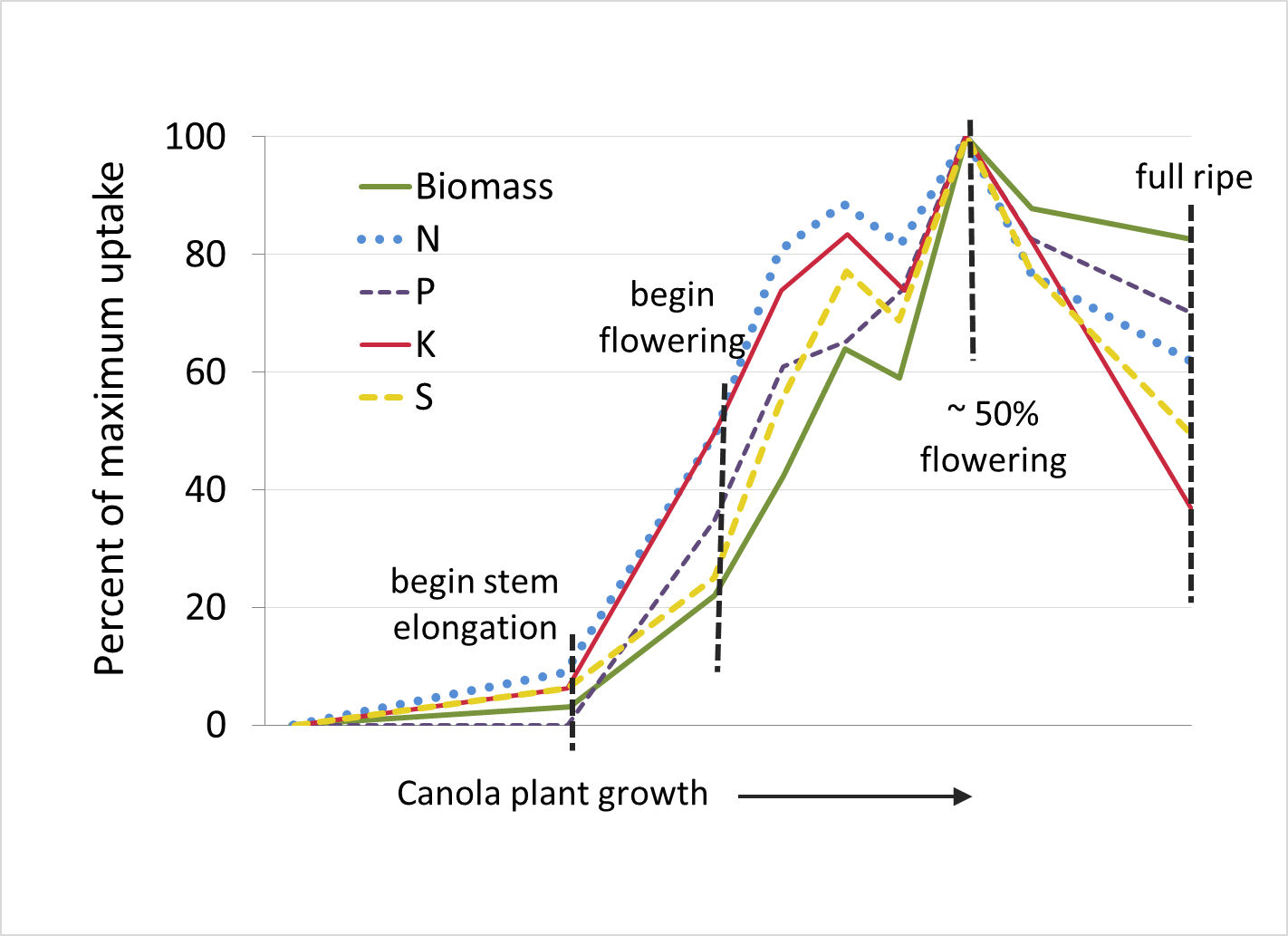
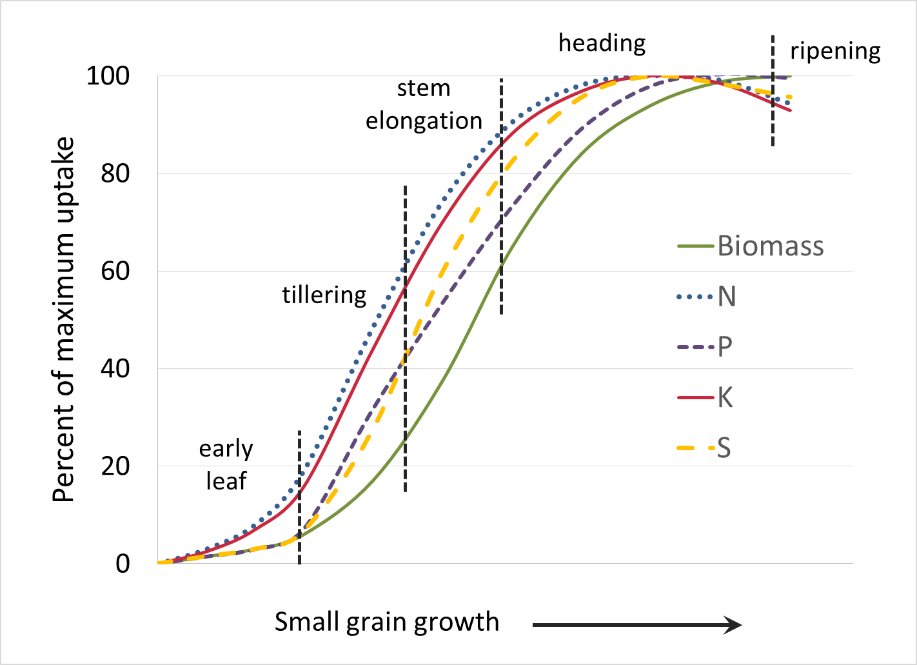
Cereals and oilseeds take up nitrogen faster than many expect*. By the time you’re ready to top up, the crop may have already locked in its yield potential based on what it sensed during early root exploration.
This month, I focus on a practical framework to help you decide when a split nitrogen strategy makes sense. I’ll also point you back to a few articles that can help you if you are struggling with what to do about the other nutrients, including the value of biostimulants, humic acids, and other non-traditional fertility sources.
*Check out more crops here: https://landresources.montana.edu/soilfertility/nutuptake.html

In case you’re new here, let me introduce myself. My name is Scott Gillespie and I’m an Alberta-based author, podcaster, and independent agronomy consultant.
I have nearly two decades of experience in dryland and irrigated specialty crop systems, working across organic, conventional, and regenerative farms. Through my consulting, my podcast (Plants Dig Soil), and my book (Practical Regeneration: Realistic Strategies for Climate-Smart Agriculture) the basis of my advice is simple:
Science-backed practices that promote environmental stewardship and farm profitability.
Same content. Different formats.
HEDGING YOUR BETS
Making split applications pay.
Splitting your nitrogen is really about keeping your options open. Instead of applying the full rate upfront, you apply enough for a low to moderate yield potential. Then, depending on how the season develops—whether you get timely rain, how the crop looks, or what the markets are doing—you decide whether or not to top it up.
It’s a way to hedge against risk. But for it to be useful, it needs structure.
A decision date: a specific point where you decide whether to go ahead with top-dressing. This should be field-specific, not a farm-wide call.
A field-readiness check: You need to assess whether the crop warrants more nitrogen and whether conditions will allow you to apply it without compacting or damaging the field.
A stop date: Past a certain growth stage, the crop won’t respond to additional nitrogen. And by then, you’re more likely to hurt the crop than help it with wheel tracks.
In cereals, most nitrogen uptake happens between tillering and early stem elongation. By the time you can feel the head in the boot, the crop has already taken up 80 to 90 per cent of its total nitrogen.
In canola, the uptake curve is similar. By 30 per cent bloom—about the time you’d be applying fungicide—the crop has taken up most of its nitrogen.
What that means is your window for in-season nitrogen is short. Once the crop senses a nitrogen shortage, it adjusts yield expectations accordingly. It doesn’t wait to see if you’ll add more.
The biggest concern for most growers is volatilization. If urea is left on the surface and not incorporated, it can gas off as ammonia—especially in warm and windy conditions. Urease inhibitors can delay that loss for about a week or two, but they don’t stop it indefinitely.
Incorporating urea by banding or through a timely rainfall helps protect it. That’s why putting it on with the seeder is generally the most efficient use of nitrogen.
When applied to the surface a half-inch to three-quarters of an inch of rain is usually enough to move it into the soil. A downpour can sometimes be too fast—if water is running off rather than soaking in, you risk losing nitrogen that way too.
Leaching is less common under Prairie conditions, especially in dryland. Sandy loam, for example, holds about 1.5 inches of water per foot of depth. Most roots in cereals and canola go down 3 to 4 feet. So even if you get a 3-inch rain, the nitrogen is still within reach. It’s worth asking: how often do you actually get that kind of rain after seeding?
Denitrification is the final loss mechanism—when saturated soils create anaerobic conditions, and microbes convert nitrate to gases that escape into the atmosphere.
Here are the important questions:
Do you often see meaningful N losses?
Are those losses consistent enough in certain areas (low spots, poorly drained) to justify managing them separately?
Can you apply N before the major uptake window closes?
Will there be rain soon after application to incorporate the N?
And will there be more rain afterwards to support extra growth?
If you can’t answer yes to most of those, split applications might not be worth the extra work.
In most cases, a well-executed all-up-front strategy checks all four boxes of the 4Rs: right source, right rate, right time and right place. The timing of seeding aligns closely with crop nitrogen demand, and there are fewer chances for loss if the N is placed correctly.
But if you’ve got known high-risk zones then splitting the application might give you more control and potentially better efficiency.
To read the complete article use the link below or look for:
Better Farming Prairies, April 2026, p.44
I know it’s late in the game for planning nutrient applications, but if you want do a quick check on where you stand, here’s an article from last fall where I discussed the value of calculating your nutrient imports and exports. If you’ve been balancing things well then you can mine the soil a little this year (for the non-mobile nutrients). If you’ve been mining it for a while the risk of low or zero rates increases.
IMPORTS VS. EXPORTS
The only soil balancing you need to do.
Excerpt:
A tool that works very well to get a big-picture view of nutrient flows is the Nutrient Budgeting App. While it was originally developed for organic growers, it is useful for those transitioning to organic production or those in conventional production who are curious about nutrient flows.
It takes a little while to enter all your imports and exports, but with scientific literature to back up the values, you can trust that the number you get will be fairly close to your actual flows.
If you just need a quick-and-dirty calculation of how much you are exporting, the Prairie Nutrient Removal Calculator is the way to go. Just select your crop and fill in your yield, and it will tell you what you are taking out. From there, you can compare the amount of fertilizer you are adding to see your net flows.
Building or mining the soil is not necessarily good or bad. These calculators only tell you the direction of nutrient flows. You must also know the starting point. For this, you need soil test values. In my last article, Test Smarter to Spend Less, I went into much more detail on soil tests and what they tell me. In that article, I said that a single test gives a snapshot and that multiple years tell a story. The story they tell you is whether you are an importer, exporter, or doing a fairly good job of balancing nutrient flows.
Let’s take phosphorus for example. You may not need a lot to get a response when you start with moderate levels in the soil. Say you’ve been putting down 15 lbs. every year for every crop with the seeder. Very likely, you’ll find that this isn’t replacing what is being exported in the grain and you might see your soil tests going down.
If you have manure available and have been adding it regularly for over ten to twenty years, you might find that you are building levels. If the soils started low and are now at moderate levels, this is good. However, if you are getting to high or excessive levels, you have a problem developing.
To read the complete article use the link below or look for:
Better Farming Prairies, October 2025, p.48.
Finally, here’s an article from last fall where I work through the value of nutrient additives. Bottom line: it’s very tough to know where they stand without on-farm testing, a luxury you won’t have if you feel forced into using them. However, please leave some check strips if you are using them to check if they did the job you expected.
NUTRIENT ADDITIVES:
Sorting the value from the hype.
Excerpt:
One reason so many “biostimulants” are on the market in Canada is regulation — or the lack of it.
Fertilizers must prove nutrient guarantees.
Pesticides must prove pest control.
Biostimulants only need to show they’re safe.
That means a product can be sold if it claims to “improve plant health,” “increase stress tolerance,” or “stimulate roots” — without proving it actually works. It’s a lower bar than fertilizers or pesticides, and it explains why the market is crowded with products making broad promises but offering little independent data.
…
With insects, diseases, and weeds, we have thresholds and predictive models. With fertility, we have soil tests and rate trials. With biostimulants we do not have this level of study.
…
If a product claims to change plant health, you might see differences visually or in satellite imagery, but what really matters is ROI — return on investment. The product either needs to cut costs while maintaining yield or improve yield beyond its cost.
Whether it uses nutrients more efficiently, allows better stress tolerance, or wards off pests, it doesn’t matter. It just needs to return you more than you put in.
Take, for example, the common cost of $20/ac. If it goes in with an existing pass on the field the only additional cost is the labour involved.
Big caution – always be sure it really is compatible. If there is crop damage the companies selling you the tank mix partners will not support you because you are adding something that they have not tested.
Back to ROI – you should really see a 2:1 or 3:1 return. If you cut other costs by $40-60/ac and maintain yield, it’s a win. If you increase yield by $40-60/ac without cutting any other costs, it’s a win.
To read the complete article use the link below or look for:
Rural Living in Lethbridge County, Fall 2025, p.22.
Closing remarks
Thanks for your attention! If something resonated let me know. I love to hear from people. Also, sharing this episode in your social networks, whether a post or to small group of your friends, colleagues, or clients, is very much appreciated. You can also support me by picking up a copy of my book, Practical Regeneration, or reaching out for agronomy support.
All the information can be found on my website:
www.plantsdigsoil.com
Here’s to growing more, believing less, and always digging a little deeper.