

Give your soil a flush
Saline & sodic soils can only be remediated if water can flow.
Pardon the bathroom humour, but it conveys a simple concept behind a complex issue: the only way to get salts and excess sodium out of soil is to flush them out.
In this edition, I'm covering the basics. You'll find a link in the show notes for the full article that I wrote for Better Farming Prairies. I'll also share my takeaways from the Canadian Farm Writers Conference last month and walk you through my fall plans.
Scott.
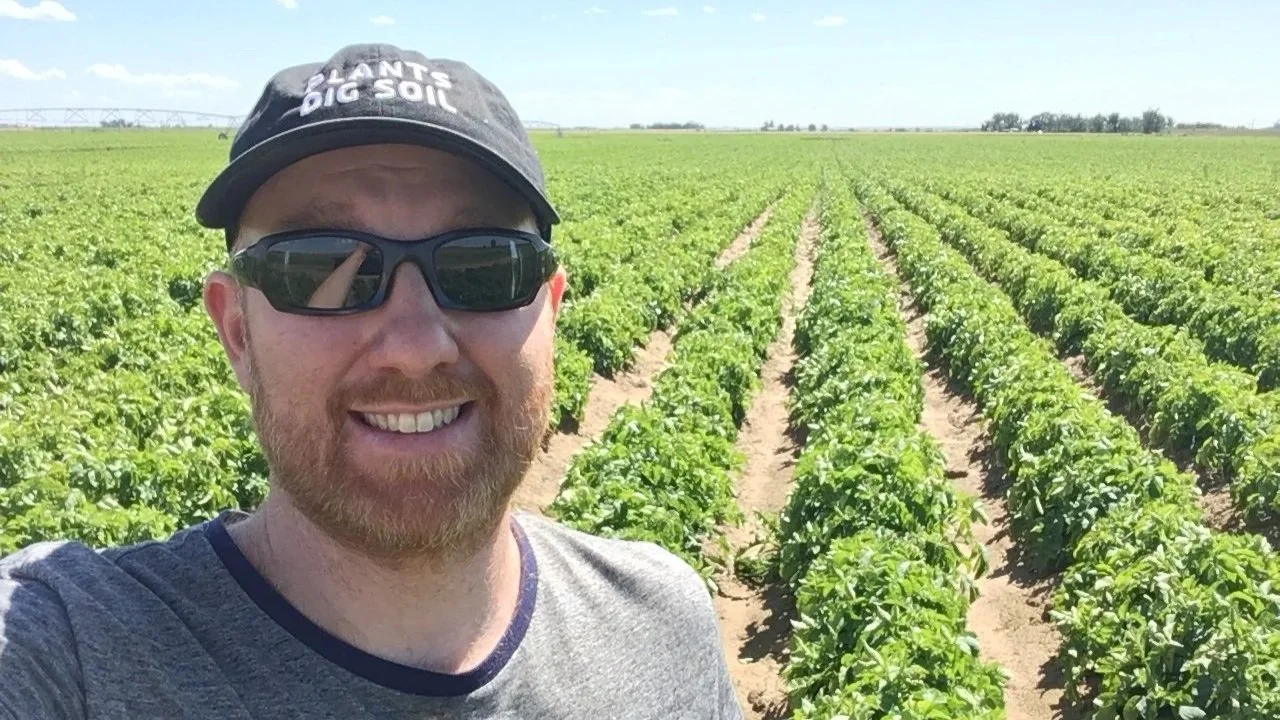
In case you’re new here, let me introduce myself. My name is Scott Gillespie and I’m an Alberta-based author, podcaster, and independent agronomy consultant focusing on practical, science-backed advice. I have nearly two decades of experience in dryland and irrigated specialty crop systems, working across organic, conventional, and regenerative farms.
Same content. Different formats.
Saline soils have a drainage problem. Water has not been able to move deeply through the profile, causing a high water table to develop, allowing salts to accumulate near the surface.
The key practice to deal with excess soluble salts is to lower the water table to be able to flush them down and out of the soil profile. They need to get below the rooting zone, generally three to five feet for most Prairie crops, so that they do not affect crop growth.
That’s the good news. The bad news is that this is not an instant fix. This is something that must be invested in now, with returns that may take 5–10 years, or longer.
Where trees naturally grow, they can be used to help draw down the water and reduce recharge. Where prairie grasses once dominated, perennial forages or native grasses with deep roots are the best tool.
If you’re not convinced this will work, please check out this article I came across that covers recent research into using plants to recover saline areas.
Reclaiming saline soils with salt-tolerant forages:
Research found that saline soils could be returned to productivity.
https://www.topcropmanager.com/reclaiming-saline-soils-with-salt-tolerant-forages/
Tile drainage can work faster than plants, but it still takes time for natural precipitation to move soluble salts out of the soil profile. It may take several years of rainfall or irrigation events to flush salts out. Once removed, the tile helps keep the water table below the rooting zone. Combining plants and drainage can speed the process—plants reduce recharge, while drainage removes salts and maintains lower water levels.
Another solution is to mulch the surface with straw. This slows evaporation which helps slow the migration of salts upwards
Manure or compost could also be applied and worked into the soil. This helps by giving the soil more structure and increases its ability to infiltrate water.
Neither method ties up salts, contrary to what I have heard claimed. They are best seen as short term fixes because the organic material eventually breaks down. It will need to be replenished or used in conjunction with deep rooted perennials and/or tile drainage.
————
Sodic soil is a soil with too many sodium cations on the soil particles. This is not the same as salinity. Salts affect the plant because the ions are dissolved in the soil water.
The sodium problem in sodic soils is embedded in the soil itself. High sodium causes soil particles to disperse, pore space to collapse, resulting in water movement slowing or stopping. This creates a cycle where water cannot move, and without water movement, the problem cannot correct itself.
The only way to improve it is to replace sodium and move it out of the root zone. While physical and biological approaches can help with salinity, sodicity requires a chemical step before those approaches can be effective.
This is where the investigations of layer thickness and composition (July edition) and chemical testing (September edition) come together. The layer must be shallow enough to be treatable, and there must be a place for the excess sodium to go.
Improving sodic soils requires three things working together: a source of calcium, water movement and time.
Gypsum is the gold standard for remediating sodic soils. Don’t confuse this with lime. Using lime will likely do nothing, and may actually make the problem worse.
To go deeper on sodic remediation, please read the full article linked below or look it up in Better Farming Prairies, Sep 2026, p.44.
Once you are done reading my article, continue on to the next one. It turns out that another contributor was thinking along the same lines as me. He’s concerned that the wet weather across most of the Prairies this year will be setting us up for increased salinity problems when the dry times come again in the years ahead.
Last month’s edition went out as I was travelling to the Canadian Farm Writer’s Conference. Through the magic of scheduled sends I was able to have everything ready to go before I left and publish automatically for me on the day I wanted.
The conference was unique in that most of the time was spent on field tours and only on the last day were there talks. Even then, most of the talks were not your normal talks: They were panels of people grouped around a common theme giving their perspective on agriculture. It was a refreshing change to the normal way of doing things.
The first day was a bit of a trip down memory lane. We went to the Outdoor Farm Show near Woodstock, Ontario. I recall going to the show when it started in the 1990’s at it’s original location. I ended up in a group with a person from Saskatchewan, Manitoba, and Ontario.
The one thing us Westerner’s noted was how much nicer it was to walk this show than Ag In Motion (held near Saskatoon every July). The Woodstock site has green grass for alleys and much more landscaping. This reflects the reality of moisture: Woodstock gets 2-3x the amount of rain in a year, allowing a living site rather than a stubble field.
The next day was all about tours. They had four buses going in four directions, but I choose the one that went close to the area I grew up in. Even though the stops we went to were within an hour of my family farm, I hardly knew them.
One tour - the Corteva Pioneer seed corn facility brought back some memories. I recall touring it as a young child or teenager. Some things have changed, but the 1970’s panelling is still present in the control room!
We also stopped at Delhaven orchard and a Brussels sprouts farm. Even though most people - including me - don’t like Brussels sprouts, someone has to grow them! They are one of the most specialized crops I’ve come across.
I took the opportunity to try out the harvester. Below is a short video of me trying my hand at it. In the field this would be creeping along with a blade right your feet to cut the stalk off.
One of the most contentious topics at the conference, unsurprisingly, was the use of Artificial Intelligence (AI). Some writers were not permitted to use it by their publisher. Some could use it for research but could not use it to create drafts of articles. Some used it freely and talked of the benefits in workflow.
At a workshop on AI I found that the ones fully against it had nothing but scorn for anything the workshop leader produced. There was no convincing them that there was a middle ground. That’s okay though. They can do things their way if they want.
I sit in the middle. I use it for research and for editing, but not to create articles. For my consulting work, I use it to bounce ideas off and and to do research, but I don’t use the information unless I’ve checked the original sources.
I’ve also found it very helpful for screening emails that get past spam filters. Due to AI, they are getting much more convincing. So, now I’m using AI to detect the AI! It can check out discussion threads, look for a real presence of the company, and analyze the text for red flags. Most of the time it says to skip, but sometimes it finds legitimate people behind the email.
————
This leads into my fall and winter plans well. My goal is to do a lot of reading and writing. I have a pile of books that I want to get through. Many have been sitting on my computer in e-book or PDF versions for years. Over the summer I worked at ordering in print versions or getting the PDF’s printed at Staples. It was costly, but I’ve been finding lately that paper books are much easier to read, make notes on, and refer back to.
I’ll also be working on any consulting projects that come my way. Over the years I’ve had a range of projects come my way in the winter. Technical reviews, expert witness reports, and providing agronomy service to farm groups are the most popular ones. If you have a project that I might be able to help you on, feel free to reach out.
My farm clients are mostly taken care of. We’ll be meeting a few times through the winter to review the year and make plans for next year. Some of the followup for them will be related to what I’m reading, and what I learn at conferences I attend this year.
And if you need help on your farm feel free to reach out. We can start simple with a small starter package and go from there. All my packages are listed on my website and can be viewed by clicking the button below.
Closing remarks
Thanks for your attention! If something resonated let me know. I love to hear from people. Also, sharing this episode in your social networks, whether a post or to small group of your friends, colleagues, or clients, is very much appreciated. You can also support me by picking up a copy of my book, Practical Regeneration, or reaching out for agronomy support.
All the information can be found on my website:
www.plantsdigsoil.com
Here’s to growing more, believing less, and always digging a little deeper.