Beyond the white crust
What soil tests reveal about tight soils
Last month, I took a short detour into physical compaction.
That edition looked at when steel helps, when roots help and when we might be expecting too much from both.
Physical compaction is the version of tight soil most people think of first: heavy equipment, moist soils, repeated passes, wheel tracks and headlands.
But that is only one version of the problem.
This month, I’m returning to my Better Farming Prairies series on tight soils and moving into the chemical side.
When people see a poor-performing patch in a field, especially one with a white crust on the surface, the explanation often comes quickly. It gets called salt. Or alkali. Or hardpan.
The problem is that those words often get used as if they mean the same thing.
A field can have salts affecting the crop. It can have sodium affecting the soil structure. It can have both. Or it can have a dense sodic layer below a surface that looks fairly normal. From the road, those problems can look similar. In the soil profile and on a lab report, they are different.
This month I’ll sort out saline, sodic and solonetzic soils
Scroll down for more details and the link to the full article.
Scott.
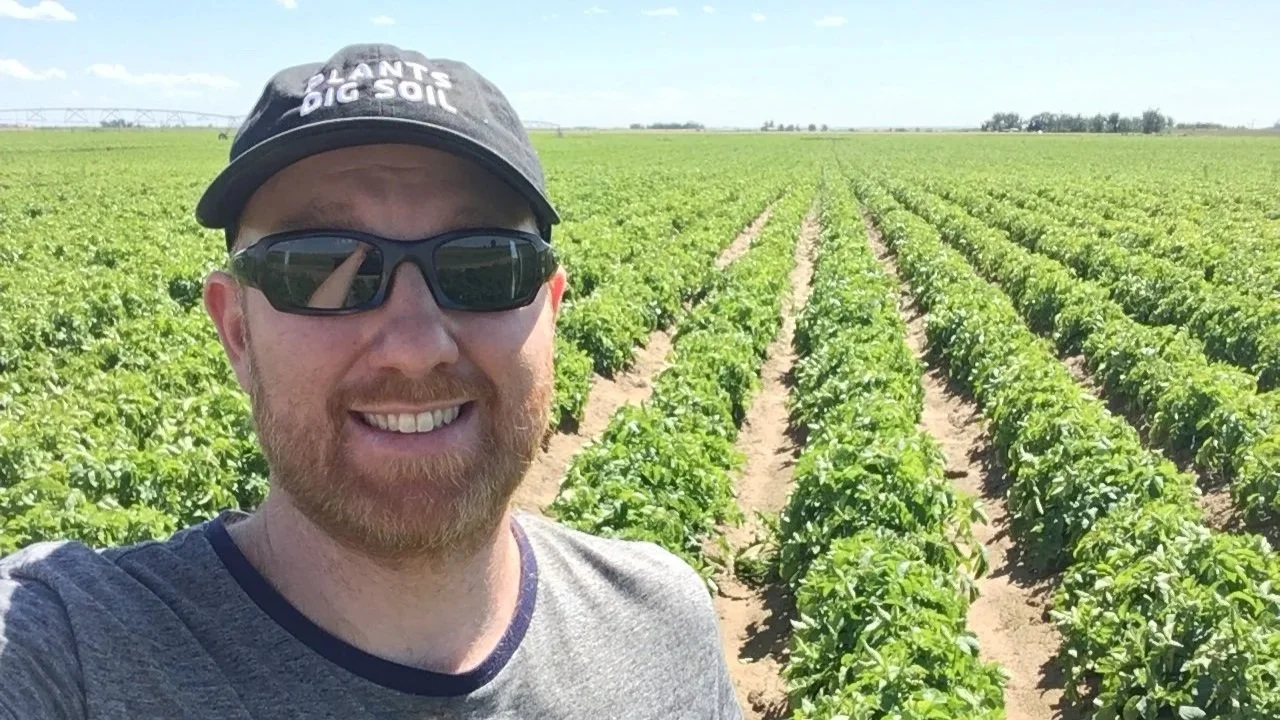
In case you’re new here, let me introduce myself. My name is Scott Gillespie and I’m an Alberta-based author, podcaster, and independent agronomy consultant focusing on practical, science-backed advice. I have nearly two decades of experience in dryland and irrigated specialty crop systems, working across organic, conventional, and regenerative farms.
Same content. Different formats.
The most obvious place to start is salinity.
Most of the time, we can see salinity. Salts crystallize on the surface after water evaporates. Those salts were dissolved in the soil water, and when the water is gone, the salts are left behind.
That white crust is useful. It tells us something is happening. But it does not tell us everything.
Salinity can also show up on a soil test as electrical conductivity. EC measures the total effect of dissolved salts in the soil water. It does not tell us which salts are present. It tells us the overall salt pressure the crop is dealing with.
That distinction matters because salinity is mainly a plant water-uptake problem.
The soil may be wet, but the crop still struggles to take up water because there are too many dissolved salts in the soil water.
This is also why saline patches tend to show up in lower parts of the landscape. These areas often have a higher water table. Water moves upward, evaporates and leaves salts behind near the surface. They can also show up along roads where natural water flow has been restricted.
Strictly speaking, salinity is not really a tight soil problem. It often gets grouped with tight soils because it shows up in lower landscape positions, which can also have heavier textures and water issues. But the main problem is not that the soil structure has collapsed. The main problem is too much salt for the crop to tolerate.
That is different from sodicity.
Sodic soil is about sodium affecting soil structure.
This is where the salt conversation gets more complicated. A salt is a compound made up of ions. When that salt dissolves in soil water, it breaks apart into those ions.
Some ions are nutrients. Calcium, magnesium and potassium are taken up by the crop and used for growth. Chloride is needed in very small amounts, but can become toxic at high levels.
Sodium is different. It has little to no useful role in most crops. It can interfere with nutrient balance. But the biggest issue in sodic soils is not simply that sodium is in the water. The bigger issue is where sodium is sitting.
Some ions are dissolved in the soil water. Others are held on the surfaces of clay and organic matter.
Those surfaces act like nutrient reservoirs. They hold positively charged ions on exchange sites and release them back into soil water as plants take them up.
That is useful when the ions are nutrients.
But sodium can also occupy those exchange sites. When too much sodium is held on the soil, structure starts to break down. Calcium and magnesium help soil particles hold together. Sodium does the opposite. It pushes particles apart, causing dispersion, collapse, reduced water movement and restricted root growth.
Excerpts from my article:
Saline, sodic and solonetzic soils are problems of soil layers. To accurately diagnose them, testing needs to be done by depth. If you have identified specific depths, use those. If not, the standard is to separate your samples into 0-6”, 6-12”, and 12-24”
Unlike standard tests that do the full suite on the surface layer and limited tests on the lower layer, you will need to get every test done on every layer.
EC measures the total effect of dissolved salts on the plant. It does not identify which ions are present, only the overall impact.
The Sodium Adsorption Ratio (SAR) measures the effect of sodium on soil structure. It indicates whether sodium levels are high enough to overcome the stabilizing effects of calcium and magnesium.
——
When combined with pH we can categorize the type of problem:
When pH is greater than 8.4 and SAR is above 13, the soil is sodic. If this occurs in a subsoil layer beneath a normal surface, the soil is solonetzic
When pH is below 8.4 and EC is above 4, the soil is saline. When SAR is also above 13, the soil is saline-sodic
Now I know that’s a lot of terminology and it can be confusing at first, but it’s important to learn when diagnosing the true cause of tight soils. To review it and get more in depth on this, please go to article linked below or search out:
Better Farming Prairies, September 2026, p. 46
In the article I go more in depth on how I identify the zones to check and I also address Base Saturation Ratios (BSR).
After you’re done reading my article, I suggest you check out the cover story. The couple featured are neighbours of mine that I’ve known for almost as long as I’ve been in Taber.
I’d like to give a little update on my fall plans. For the past three years I’ve taught a couple courses at Lethbridge Polytechnic to the agriculture diploma and degree students. I decided early this summer that I didn’t want to go back.
I loved doing it, but the time involved was taking away from what I could done in the off season. Although it was only two classes and a lab, it ended up taking up 2-3 days in teaching alone, and the rest of the days were mostly taken up in preparation and marking.
I’ve also learned that I really love writing. Teaching is a lot tougher because you need to be in a specific place at a specific time, and you need to try to motivate people to learn.
It’s a lot of work.
I love getting up and giving presentations at conferences, and hope to continue that work, but imagine having to do that four times a week, for over an hour each time, plus teach two 2-hour labs, for 3 months!
I really have gained a lot of respect to those that can do it. I may go back to teaching if the opportunity arises again, but for now, I feel I’m done with this .
As I thought more about this I remembered something that one of my favourite writers said. Robertson Davies loved the theatre. He loved acting and he was an avid theatre goer his whole life. Had it not been for World War II he may have spent his life working in London, England at the Old Vic.
He penned many plays and had a few of them produced, but he found the whole process frustrating. His vision for what it could be depended on the talent of the actors, the facilities that were available, and whole bunch of people that worked behind the scenes (literally, in this case) to make it happen.
He found that novels gave him that control. It was just him in a room typing what came to mind on his typewriter. I feel that same urge.
No, I’m not planning to write novels. And no, I’m planning to go back to a typewriter. But I would love to have open time to just write. I have next year’s articles to work on, but I also feel I have another book to write. If I take the time that would have went into teaching to focus on this, I feel many great things can happen.
Another thing that teaching limited me on was the ability to go to fall conferences. I’m taking advantage of this newly found open time to go the Canadian Farm Writers Conference in London, Ontario this year. I’m not sure what to expect but I’m hoping to meet a lot of new people and maybe find some new opportunities for writing.
Closing remarks
Thanks for your attention! If something resonated let me know. I love to hear from people. Also, sharing this episode in your social networks, whether a post or to small group of your friends, colleagues, or clients, is very much appreciated. You can also support me by picking up a copy of my book, Practical Regeneration, or reaching out for agronomy support.
All the information can be found on my website:
www.plantsdigsoil.com
Here’s to growing more, believing less, and always digging a little deeper.