Planning Starts at Harvest
Intro
We are finishing up our fourth winter here and are looking forward to a very warm fourth spring. It’s currently +10C and it might even get close to +20C later in the week. The Chinook winds are blowing hard down the Rockies right now.
Although it might seem like spring here, we know winter will come back. So it’s a good time to focus on planning now. For this edition I want to tie together two recent magazine articles that I wrote.
One article looks at pest control through a post-harvest lens — basically treating the season to a post-mortem. The other looks at seed decisions, especially around saved seed versus certified seed.
They seem separate, but they’re really two halves of the same idea: the season doesn’t start at seeding — it starts at harvest.
If you live south of Calgary, the event planned by Foothills County for December was rescheduled to the end of this month. My talk is called: The Builder, The Banker, The Brewer: Balancing Soil Physics, Chemistry, and Biology in Prairie Fields.
It’s a free event on the afternoon of January 28th. Lunch is included.
Registration is at:
https://www.eventbrite.com/e/the-builder-the-banker-the-brewer-tickets-1978190561220
Bio
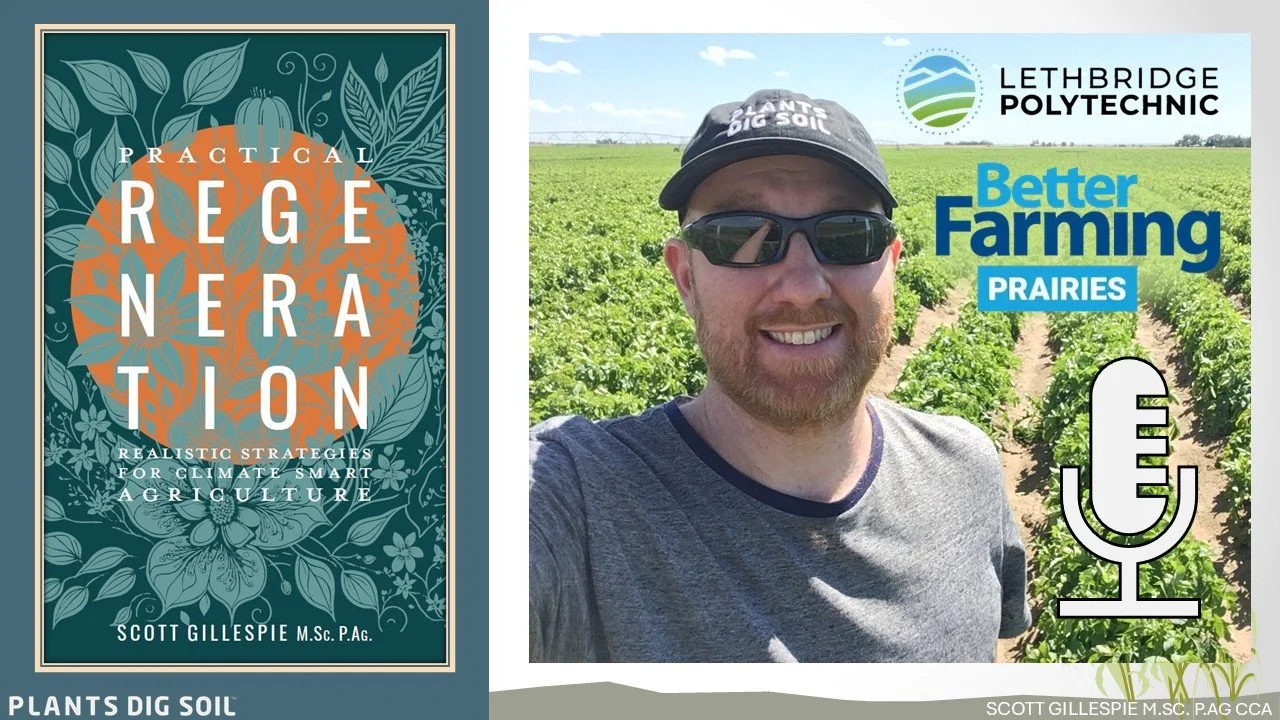
In case you’re new here, let me introduce myself. My name is Scott Gillespie and I’m an Alberta-based author, podcaster, and independent agronomy consultant specializing in #RealisticRegenAg.
I have nearly two decades of experience in dryland and irrigated specialty crop systems, working across organic, conventional, and regenerative farms. Through my consulting, my podcast (Plants Dig Soil), and my book (Practical Regeneration: Realistic Strategies for Climate-Smart Agriculture) the basis of my advice is simple:
Science-backed practices that promote environmental stewardship and farm profitability.
Same content. Different Ways to consume.
Planning Starts at Harvest
Harvest is when the crop finally shows its true colours. During the season, crops are great at hiding problems. Canopies close, weeds get shaded out, diseases can stay hidden, and the field can look pretty good on the gravel road drive-by.
Once the grain is in the bin, though, the shine can come off. Grain samples are one of the most valuable tools we have. They don’t just tell you grade — they tell you what got missed. Fusarium that never really showed. Midge damage that didn’t cause a yield hit, but still cost quality. Ergot bodies that remind us how rotation and field edges still matter.
And that’s before we even get into maps. Yield maps and NDVI don’t just show yield. They show patterns. Edges, bubbles, low spots, headlands. All of those signatures are clues.
The trick is not jumping to conclusions. An ugly weed patch doesn’t automatically mean herbicide resistance. A clean sample doesn’t mean zero risk. A high-yield area doesn’t mean you need to push it harder next year.
The real value comes from asking better questions:
Was that a pest issue, or a weather issue?
Did that problem repeat across years, or was it a one-off?
Does this line up with rotation history, or with soil and water movement?
If you don’t pause to ask those questions, planning quietly defaults to habit.
Here’s where this really pays off.
When you do this kind of post-harvest thinking, it makes in-season decisions easier and calmer.
Instead of reacting to every headline or forecast, you already know where your true risk is. You know which fields deserve closer watching, and which ones are probably fine.
That doesn’t mean fewer decisions — it means better timed ones.
And this is something I see over and over again: the people who do the best job of reviewing last year are the ones who feel the least stressed mid-season. They’re not guessing as much. They’re adjusting.
To dive deeper, please check out my full article in Better Farming Prairies, Pest Control Post-Mortem: Applying this year’s lessons to next year’s crop.
Seed is one of those inputs that feels routine, but it’s actually one of the biggest levers we have. If you’re using farm-saved seed, planning starts before harvest. Pre-harvest products, harvest timing, storage conditions — all of that affects what that seed will be capable of next spring.
And here’s the mistake that’s easy to make: if bin-run seed worked fine last year, it feels logical to assume it’ll work fine again.
Sometimes that’s true. Sometimes it isn’t.
Germination tests are useful, but they only answer one question: Will it sprout under ideal conditions? They don’t tell you how that seed will handle cold soils, variable moisture, or disease pressure. Vigour is what gets you through tough springs.
Certified seed isn’t magic, and it isn’t always the right answer. But what it does give you is a reset: genetics, disease load, and performance
When you actually pencil it out — cleaning losses, trucking, storage, increased seeding rates — the economics aren’t as one-sided as they first appear. Some years bin-run wins. Some years it doesn’t. The danger is assuming the answer instead of checking.
Lower vigor seed can mean slower emergence. Slower emergence can mean more weed pressure. More weed pressure can mean more chemistry, or narrower application windows, or more stress.
Likewise, disease carried on seed doesn’t always show up as a dramatic failure. Sometimes it just shaves a little off establishment, which then shows up as uneven competition all season.
When people say, “That field was just rough-looking this year,” a lot of the time it’s actually a stack of small decisions interacting.
To read the full article, Seed Sense: What a garden failure taught me about farm-saved seed, go here:
https://www.betterfarming.com/flippingbook/better-farming-prairie/2026/january/44/index.html
Closing remarks
Thanks for your attention! If something resonated let me know. I love to hear from you. Also, sharing this episode in your social networks, whether a post or to small group of your friends, colleagues, or clients, is very much appreciated. You can also support me by picking up a copy of my book, Practical Regeneration, or reaching out for agronomy support.
All the information can be found on my website:
www.plantsdigsoil.com
Here’s to growing more, believing less, and always digging a little deeper.