

I promise: This is the last of the soils articles for a while. In the new year I’ll get into seeding prep, drone use, and data integrity on the farm.
I’ll cover the basics here but the full article goes into much more depth.
I’m going to take December off for the newsletter and get going again in January. Just in case you’re not saturated on soils information, I’ll link to one that was published in the Rural Living in Lethbridge County recently on soil colours.
Scott.
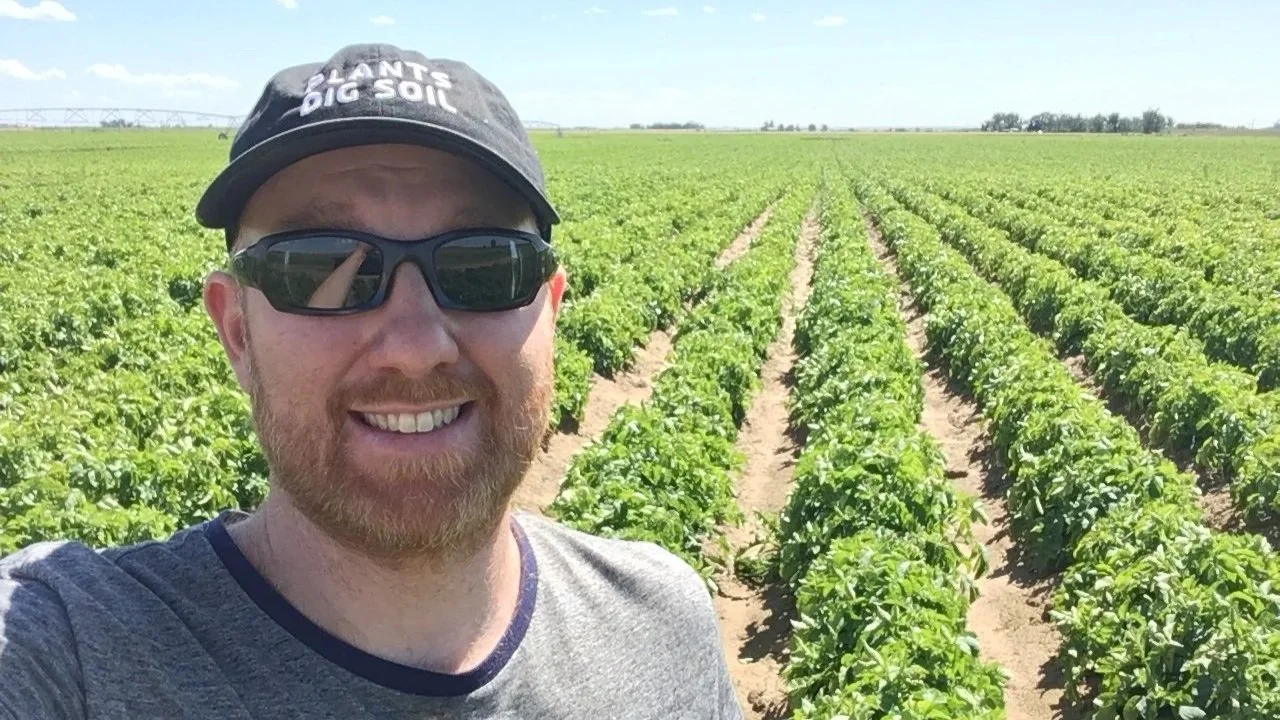
In case you’re new here, let me introduce myself. My name is Scott Gillespie and I’m an Alberta-based author, podcaster, and independent agronomy consultant focusing on practical, science-backed advice. I have nearly two decades of experience in dryland and irrigated specialty crop systems, working across organic, conventional, and regenerative farms.
Same content. Different formats.
Saline-sodic soils contain both high salts and high sodium.
At first glance, these soils can be misleading. The presence of salts can actually help hold soil particles together, so structure may appear better than expected. Water may still move through the soil, and it may not feel as “tight” as a sodic soil. Crops may struggle, but the soil itself can still function to some degree.
However, that stability depends on those salts remaining in place.
If salts are removed without addressing sodium, the situation can change quickly. As salt levels drop, the effect of sodium becomes more pronounced. Soil particles begin to disperse, structure collapses and water movement declines. What once allowed water to move through the soil profile can become sealed and restrictive.
In trying to fix salinity, the harmful effects of sodium on soil structure and water movement can become more pronounced.
Solonetzic soils are a layered problem (pun intended). In these soils a relatively normal surface layer sits above a dense, sodic subsoil.
Crops may establish reasonably well and early growth can appear acceptable. The issue becomes apparent later, as roots and water movement are restricted once they reach the dense layer below.
Water tends to accumulate above this layer, leading to pooling after rainfall. Roots often stop abruptly at the boundary, unable to penetrate deeper. This results in crops that struggle in both wet and dry conditions, as they are unable to access deeper moisture or drain excess water effectively.
A clue to solonetzic soils is a wavy pattern of crop growth across the field. Instead of distinct patches like you might see with salinity, the crop often appears uneven in bands or waves, with areas of stronger growth beside areas that are stunted.
This crop pattern reflects what is happening below the surface. Solonetzic soils contain a dense, sodic layer that is not uniform in depth or thickness. In some areas, the layer is shallower or more restrictive, limiting root growth and water movement. In other areas, it is deeper or less severe, allowing crops to access more moisture and nutrients.
The tough decision
In the case of both of these types of soil there is usually no easy fix. Geologic processes have caused the problems. They need drainage, they need some kind of soil amendment, they might even need deep tillage or deep ripping, and they need time and lots of water to flush the sodium and salts out. To learn more, please go to the complete article linked below.
Better Farming Prairies, Nov/Dec 2026, p.50
Brown soils are formed under dry conditions where evapotranspiration (soil water evaporation + plant water transpiration) often exceeds precipitation. Brown soils cycle nutrients quickly when moisture allows. That rapid cycling can be an advantage in good years, but it also means that organic matter is difficult to build and maintain.
Dark Brown soils represent a transition to soils that get more precipitation and, just as importantly, a slightly shorter season with slightly more moderate temperatures. These factors combine to allow them retain more organic matter, thus, their darker brown colour.
Black soils form where moisture is more reliable, the season is shorter, and temperatures are cooler. Plant growth is vigorous, residue inputs are high, and decomposition slows just enough for organic matter to accumulate.
Grey soils form as the landscape transitions from prairie grass to forest. Precipitation is often greater than evapotranspiration and a cool climate means leads to slow nutrient cycling. Deep water movement becomes strong enough to wash colour-forming materials out of the upper mineral soil.
Peat soils form where soils remain saturated for extended periods of time. Oxygen is limited, microbial activity slows dramatically, and plant material accumulates faster than it decomposes. Over time, organic matter builds to levels far beyond what we see in mineral soils.
To go more in-depth on these types of soils follow the link below
Rural Living in Lethbridge County, Fall/Winter 2026, p.25
The conference season has begun.
Next week I’m going to a new conference called simply the Southern Alberta Ag Producer Conference. It’s put on by SouthGrow and looks promising. Over two days there will be sessions on water, people, markets, and innovation. If you’re in my area let me know if you’ll be there. Tickets are still available as I send this. At $160 for two days it’s a good deal, and there are no hotel stays or long travel required.
https://www.eventbrite.ca/e/southern-alberta-ag-producer-conference-tickets-2001916463031
I’ll also be going to a free talk next week as a part of the University of Lethbridge’s Public Professor Series. The talk is by Dr. Danny Leroy and is titled: The curious task of economics and why it matters more than ever in Canadian agriculture. Right now, there are no spaces left but you can get on the waiting list by going to the link below:
https://www.ulethbridge.ca/public-professor#upnext
In the new year I’ll setup in my cozy chair for two days of learning through Agronomy Update. It was in-person prior to Covid and alternated between Red Deer & Lethbridge, but has shifted online ever since. At $40, it’s probably on of the best deals out there. You can find out more here:
https://www.agronomyupdate.ca/
I’m conflicted on two events in the third week of January.
One is local, the Irrigated Crop Production Update in Lethbridge (https://give.lethpolytech.ca/event/irrigated-crop-production-update-2027/e843191).
The other is in British Columbia, which sounds like a nice break in the middle of winter. It’s the Lower Mainland Horticulture Conference (https://www.agricultureshow.net/lower-mainland-horticulture-improvement-association/).
I’ll wait for the agendas and make my call in December.
Beyond those plans, I have a bunch of reading that I want to get to along with getting ahead on my article for Better Farming Prairies.
If there’s anything I can help you with, please get a hold of me to chat. Over the years I’ve had a range of projects come my way in the winter. Technical reviews, expert witness reports, and providing agronomy services to farm groups are the most popular ones.
As always, if you need help on your farm feel free to reach out. We can start simple with a small starter package and go from there. All my packages are listed on my website and can be viewed by clicking the button below.
Closing remarks
Thanks for your attention! If something resonated let me know. I love to hear from people. Also, sharing this episode in your social networks, whether a post or to small group of your friends, colleagues, or clients, is very much appreciated. You can also support me by picking up a copy of my book, Practical Regeneration, or reaching out for agronomy support.
All the information can be found on my website:
www.plantsdigsoil.com
Here’s to growing more, believing less, and always digging a little deeper.